|
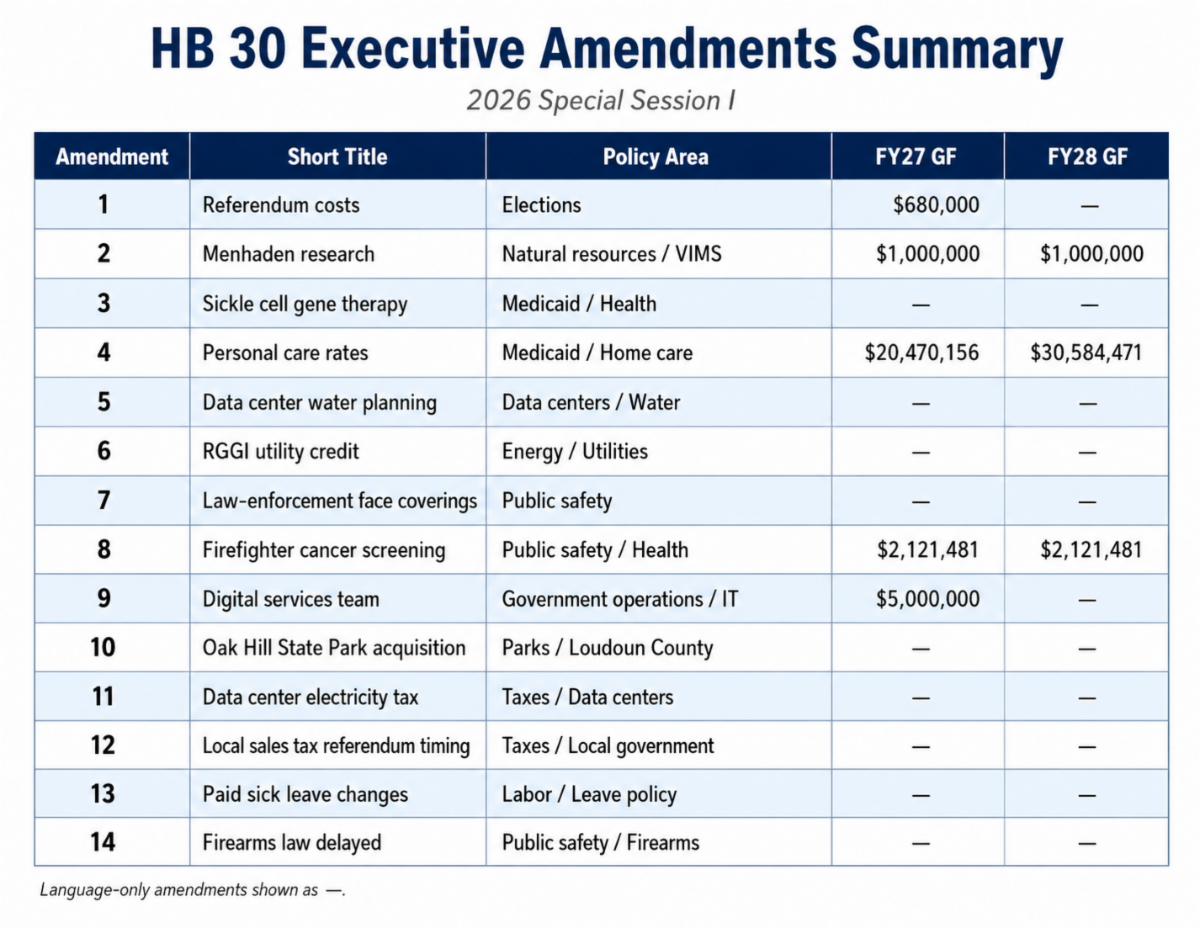
5.) A near win for Jefferson Forum on Paid Family and Medical Leave Act (PFMLA) definitions (Amend. 13). The Jefferson Forum was one of the only groups (maybe the only) to point out that Virginia’s PFMLA law allow workers to take leave to care for family and people they consider to be “like family.” Governor Spanberger first amended the original bill to require the non-family member being covered to live with the caretaker. The Jefferson Forum pointed out that this was better, but still was too expansive and expensive as anyone could move in a friend to qualify for coverage. Gov. Spanberger has now submitted an amendment to the must pass budget that further restricts coverage by requiring the non-relative receiving care under this act to have a “reasonable expectation that the employee care for such persons and that their care depends on that employee.” While slightly better, it is impossible to measure “expectations” of care – and is thus still open to abuse. The Governor should limit care to family members as is done in every other state with a PFMLA. Progressives want the nanny state to have no limitations and workers to be allowed time off to care for almost anyone, for almost any reason. This bill, even with the amendments, will eventually break the budget, increase payroll taxes, and drive away employers!
6.) Masks for law enforcement are ok after all (Amend. 7). While the extreme left have gone fully anti law enforcement and anti-ICE – including putting ICE lives at risk of being doxed and murdered by not allowing them to conceal their identity, Governor Spanberger submitted an amendment to the budget to allow law enforcement to use facial coverings under certain circumstances. It exempts officers when concealing their identity is necessary. The language appears unclear on whether ICE officers will be exempt — not that Virginia can really ban federal officers from covering their faces anyway.
7.) Expands Regional Greenhouse Gas Initiative (RGGI) credits to ratepayers (Amend. 6). Governor Spanberger submitted a budget amendment to add customers of electric cooperatives to the RGGI credit that seeks to return 45 percent of RGGI revenue back to rate payers. This is further proof that Governor Youngkin was right to get Virginia out of RGGI as the Jefferson Forum long advocated, and that this RGGI tax is a major impediment to the Governor’s affordability agenda. Why collect a tax to only rebate almost half of it back? This is potentially the dumbest tax and credit back idea ever!
8.) James Monroe’s house to become state park (Amend. 10). Despite failing to get enough votes three times in the General Assembly, Governor Spanberger is now using the must pass budget amendment language to accept 1,250 acres in Loudoun County to establish the Oak Hill State Park, with some contingencies for non-general fund revenue obligations. Legislating in a must pass budget to approve bills previously rejected by the General Assembly is a bad habit to begin — just look across the river to DC and see how that has worked out.
9.) One more regulation for data centers (Amend. 5). Governor Spanberger added a budget amendment to require data centers in the Eastern Virginia Groundwater Management areas to demonstrate water efficient cooling practices.
10.) More money for home care service under Medicaid (Amend. 4). This is the largest spending amendment which gives higher pay rates for home care services and speeds up the increases — adding $51 million in general fund spending and $57 million in non-general fund spending over the biennium. This is one budget item ripe for auditing, as home health care is so easily abused.
EDUCATION
11.) Unfunded teacher raises. Virginia’s newly proposed state budget includes a 4% teacher pay raise, exceeding the 3% increase previously anticipated by districts like Bedford County Public Schools. This late, unexpected adjustment has left local school divisions scrambling to identify funding sources to cover these mandatory costs. School officials criticize the state’s approach as an “unfunded mandate,” noting that the state only provides funding for Standards of Quality (SOQ) positions. Consequently, districts must independently cover the raises for remaining staff, a significant financial burden coming just days before the end of the fiscal year. With the budget awaiting the Governor’s signature by June 30, school districts remain in a state of uncertainty while planning for the upcoming school year. The chaos of this budget process should have consequences for those that led us down this path.
12.) Adding a three-year degree to college offerings. Virginia and Ohio are taking a step toward increasing “educational efficiency” by joining the “Scaling College in 3” initiative. This move seeks to design a 90-credit, three-year bachelor’s degree, challenging the traditional 120-credit requirement. It is hoped that by reducing time and costs, and by eliminating what they consider non-essential coursework, they can better align degree programs with workforce demands and student needs. My initial impression is that this is further proof that much of what is being taught in college is drivel, indoctrination, or entertainment. This new degree will likely be viewed as “less than” a full four-year degree by employers, and be more akin to a slightly better associates degree.
DATA CENTERS
13.) Data Centers significantly benefit the Commonwealth. Based on Cardinal News, two reports from Virginia’s Joint Legislative Audit and Review Commission (JLARC) highlight that the state’s data center tax exemption is highly effective, ranking as Virginia’s second-best economic incentive overall. Key benefits of data centers and the incentive include:
- High Proportional Returns: For every $1 million invested via the tax exemption, data centers generate $10 million in gross domestic product (GDP) and $6.1 million in personal income.
- Job Creation: Despite not being traditionally massive employers, data centers produce 84 jobs per $1 million of incentive, yielding higher-income positions and outperforming all other incentives except state grants.
- Revenue Clawback: For every $1 spent on the exemption, the state recovers 48 cents in tax revenue through alternative channels.
-
Top-Tier Ranking: Out of 75 specific incentive programs evaluated, the data center tax break was the only tax exemption to receive the highest possible score (a 4 out of 4) for both economic benefits and state revenue return.
14.) Data Centers significantly benefit counties. The Wall Street Journal published an article by former Virginia Energy Director Glenn Davis highlighting a significant split in how neighboring Virginia counties approach the growth of the artificial-intelligence economy. Loudoun County has actively embraced data centers, transforming them into a cornerstone of its fiscal health generating approximately $1.3 billion in tax revenue in 2027, covering nearly 45% of the county’s total tax income. This influx of capital allows the local government to robustly fund essential public services—including police, fire and rescue, libraries, and parks — with minimal additional tax burden on residents. Conversely, nearby Prince William County has been more hesitant, frequently exhibiting “Nimby” (Not In My Backyard) attitudes. The piece underscores that the future of U.S. AI development is being shaped not just in tech hubs, but through local zoning decisions – and after this budget is signed, by ill-informed state energy and tax policy.
OTHER
15.) Private Cannabis Markets Concern Public Alcoholic Beverage Control (ABC) Authority. The Virginia alcohol industry warns that a new plan to utilize ABC Authority special agents to help launch the state’s retail cannabis market threatens public safety. By diverting these trained professionals away from their primary duty of overseeing over 30,000 alcohol licenses, the state risks weakening oversight of existing alcohol regulations. Industry groups argue that the provision is dangerously broad and lacks essential details on staffing and duration. They contend that sacrificing established, effective alcohol enforcement to support the untested cannabis market is irresponsible and risks compromising the safety of all Virginians who consume alcohol. This makes me think, wouldn’t the justification for ABC stores also apply to cannabis markets? Why are we trying to license 350 cannabis stores when we could just utilize the 450 ABC stores around the Commonwealth to sell cannabis? Or better yet, we could decriminalize cannabis, instead of creating a market that will encourage greater use and greater social costs as I wrote here. Oh wait, this isn’t about doing what is right, it is about appeasing Sec. Lucas who wants her constituents to have easy access to mind altering drugs…
16.) Has Haner gone soft? Jefferson Forum’s Steve Haner appears to support the proposed pay raise for Virginia legislators in the budget, arguing in WVTF Public Media that legislator salaries have been “ridiculously low” for nearly 40 years. Haner notes that the 1990s recession led to a 2% cut that left House members underpaid compared to the Senate for decades. While Haner opposes a full-time, year-round legislature, he emphasizes that the job requires near constant availability for constituent demands. Haner views the upcoming 2027 elections as a legitimate platform for voters to challenge incumbents on the increase. As always, Haner makes a strong argument.
17.) After the New York primaries, I thought a reminder from the Gipper that when fascism comes to America, it will come in the name of liberalism…you have been warned!
| 










Leave a Reply