



“Gerrymandering is detrimental to our democracy, and it weakens the individual voices that form our electorates. Opposing gerrymandering should be a bipartisan priority.”
– Governor Abigail Spanberger
President John Adams famously said, “Facts are stubborn things.” We would add, “Everyone is entitled to his own opinion, but not his own facts.” In recent weeks, supporters of the amendment have written “Letters to the Editor” that have included assertions that do not withstand scrutiny. Four of them are particularly misleading or incorrect.
First, proponents claim the referendum is a “temporary solution.” This assertion is – at best – dubious. While redistricting authority could go back to the Virginia Redistricting Commission in 2030, the boundaries established under the amendment would remain unchanged unless the Commission acted to alter them. There is no guarantee such changes would occur, especially with a partisan Democrat legislature.
Second, a writer has claimed that the “Virginia Supreme Court overturned the Tazewell County Circuit Court decision.” This is false. The Virginia Supreme Court has issued no ruling on the merits of the Tazewell County case. Instead, it has deferred consideration until after the April 21, 2026, referendum vote.
Third, supporters describe the amendment as an “emergency exception to current redistricting,” yet they present no evidence to support this claim. Where is the emergency? Virginia’s Governor, Lieutenant Governor, and Attorney General are all Democrats, as are the majorities in both the State Senate and House of Delegates. Democrats also hold six of Virginia’s eleven U.S. Congressional seats. Given the extraordinary distortion of the proposed districts, reasonable people can only conclude that Virginia’s Democrats intend to establish a super-majority that effectively makes Virginia a one-party state like California, New York, Maryland, Massachusetts, and Illinois – among others.
Fourth, proponents argue that Virginia must “level the playing field” with Texas. This comparison is a red herring that distracts from the central question: “What constitutes fair representation for the citizens of Virginia, and how can it best be achieved?” The design of congressional districts in other states is irrelevant to Virginia’s citizens, whose primary concern should be how redistricting affects representation within the Commonwealth.
Moreover, the Texas comparison misrepresents the facts. Texas redrew its congressional maps under circumstances fundamentally different from Virginia’s. Unlike Virginia, Texas has no constitutional prohibition on mid-decade districting. More importantly, Texas has experienced substantial population growth – from 29.1 million residents in 2020 to 32.4 million today, necessitating updated maps to account for an increase of more than three million new residents.
Federal courts required Texas to redraw its districts to account for this growth, much of it driven by internal demographic changes – largely in the Hispanic community – and a large influx of new residents from other states. Contrary to claims that Texas’ redistricting harmed minority voters, three of the newly-drawn districts have Hispanic majority populations. These demographic realities bear little resemblance to Virginia’s situation. They certainly don’t justify altering Virginia’s constitutional redistricting framework.
According to the non-partisan Virginia Public Access Project, Virginia has seven Democrat-leaning districts, one competitive district, and three Republican-leaning districts, resulting in a congressional delegation of six Democrats and five Republicans. Under the proposed amendment, representation would in all likelihood shift to ten Democrats and just one Republican. While Republican and conservative-leaning voters comprise slightly less than half of the electorate, they would hold only nine percent of Virginia’s congressional representation.
Under the proposed plan, written by George Soros lawyer Marc Elias, Fauquier County would be divided between two Congressional Districts. The reconfigured District 7 would include southern Fauquier County and parts of fourteen other localities including the City of Falls Church and parts of Arlington, Fairfax and Prince William. A redesigned 11th Congressional District would include northern Fauquier County and portions of nine other localities, including Manassas, Manassas Park, and parts of Fairfax, Prince William, and Rappahannock counties.
These proposed districts raise serious concerns under Virginia’s constitutional requirements for “compactness” and “contiguity.” Together, they would extend from the Potomac River to West Virginia and south to Buckingham County in Central Virginia. In each district, a small portion of Fairfax County would constitute more than half of the voting population – if not more. Fairfax County already exerts disproportionate influence on the General Assembly, with forty State Senators and Delegates residing there. None of them are Independents or Republicans. Fairfax politicians hardly represent the values and interests of rural Virginia.
Under the proposed map, Fairfax County would dominate five of Virginia’s eleven districts. This outcome further calls into question dubious Democrat claims of fairness and balance. Rather than promoting competition, the amendment would effectively repudiate the voterapproved Nonpartisan Redistricting Commission and lock in a lopsided congressional delegation – the antithesis of fairness. Even the Washington Post Editorial Board has criticized the proposal as a “brazenly dishonest attempt to gain a partisan advantage under the guise of fairness.”
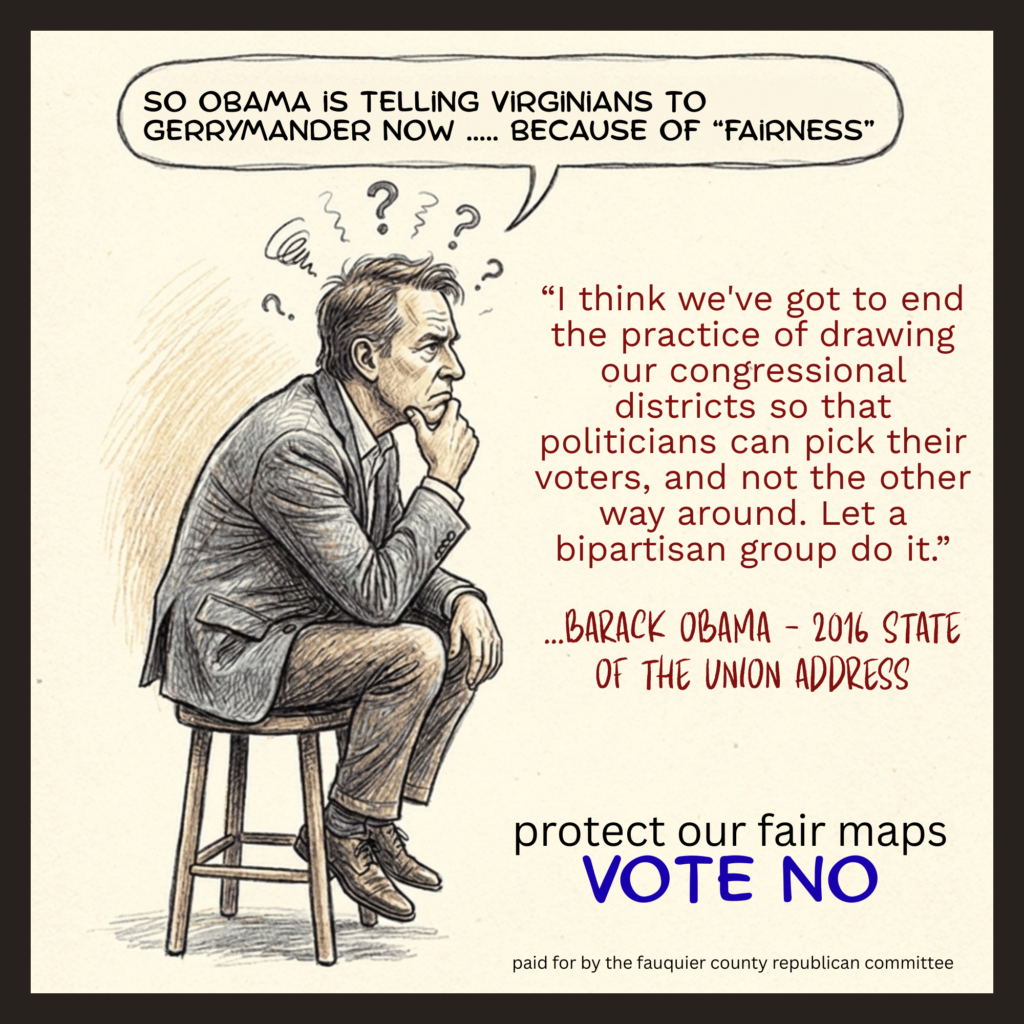
Don’t enable the disenfranchisement of your vote. Make your vote count for true fairness, not the Democrat misrepresentation of it. VOTE NO on this democracy-killing Democrat referendum! Stand with the non-partisan Redistricting Commission that Virginia voters overwhelmingly supported just four years ago!
Leave a Reply